



Charcot-Marie-Tooth, or CMT, is the most commonly inherited peripheral neuropathy (genetic nerve disease) and is found world-wide among all races and ethnic groups. Discovered in 1886 by three physicians, Jean-Martin Charcot, Pierre Marie, and Howard Henry Tooth, CMT affects an estimated 3 million people.
What Are the First Symptoms of CMT?
The initial symptoms of Charcot-Marie-Tooth disease, or CMT for short, are usually first noticed when an individual develops lower leg weakness and foot drop, altered gait/way of walking, foot deformities such as hammertoes and high arches, and numbness and tingling in these same areas. These symptoms alone are not enough to diagnose CMT, however, and the individual is usually referred to a neurologist.
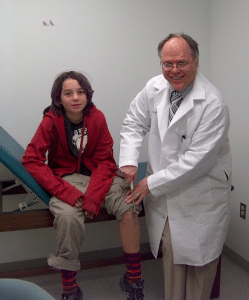
A visit to a neurologist typically starts with a physical exam to look for further signs of weakness and sensory loss (distal = points farthest from the spine). To identify weakness, an individual may be asked to walk on their heels or move their legs against an opposing force. Sensory loss is often identified when the doctor pokes an individual with a pin or touches a tuning fork on the toe and these sensations are not felt or are only felt a little.
Is There a Family History of CMT?
Since CMT often runs in families, it is important to tell the doctor or genetic counselor about any other family members with CMT-like symptoms. Lack of family history does not rule out CMT, but it will cause the doctor to look further to rule out other causes of neuropathy, such as diabetes or exposure to certain chemicals or drugs. Further testing may be electrodiagnostic, genetic, or both.Electrodiagnostic Testing for CMT (NCS and EMG)
CMT is divided into three basic groups of neuropathy: demyelinating, axonal, and intermediate. Each is determined by nerve conduction study (NCS) results. A nerve conduction study (NCS) is a test doctors use to see how well the peripheral nerves transmit a signal. In CMT, NCS results have certain parameters that tell the doctor if the individual has a demyelinating CMT subtype, an axonal CMT subtype, or an intermediate subtype. Intermediate refers to NCS results and not to disease severity or progression. CMT1 is the clinical diagnosis for demyelinating CMT and CMT2 is the clinical diagnosis for axonal CMT. Intermediate CMT is rarely used as a clinical diagnosis. Instead, doctors usually favor a CMT2 clinical diagnosis if NCS results are intermediate.
Often done at the same time as NCS but is a different test, electromyogram (EMG) is used to measure the strength of the peripheral nerve’s electrical signals in the muscles of the arms or legs. Both tests are generally performed by a lab technician, a neurologist, or a doctor specializing in physical medicine and rehabilitation (a physiatrist).
What Is a Clinical CMT Diagnosis?
A clinical CMT diagnosis is a diagnosis based on symptoms that are consistent with CMT, and on NCS results prior to obtaining genetic confirmation. A CMT genetic confirmation is sometimes referred to as a genetic diagnosis. Doctors will clinically diagnose an individual with CMT1 or CMT2 based on NCS results. Clinically, there’s not much difference between CMT1 and CMT2, except for NCS results, although CMT2 might cause greater muscle atrophy in the lower legs, feet, and hands than CMT1 when age matched (two individuals who have CMT and are the same age). By itself, this is not diagnostic though.
Once the underlying responsible gene mutation is identified, the diagnosis is transitioned to the related subtype—CMT1H, for example. CMT1 is a group of 11 subtypes that are each demyelinating as determined by NCS results. However, there are currently 29 demyelinating CMT subtypes. Therefore, a clinical CMT1 diagnosis might not remain a CMT1 subtype diagnosis should CMT genetic testing provide genetic confirmation.
What is CMT1 (CMT1 Clinical Diagnosis)?
CMT1 is the clinical diagnosis doctors use when NCS results show a demyelinating CMT. The NCS general rule-of-thumb for demyelinating CMT is nerve conduction velocities less than 38meters/sec (the speed at which the nerve transmits a signal), slightly reduced amplitudes (signal strength), prolonged latencies (how quickly the nerve responds to an input signal), fairly uniform findings in all nerves tested, and some nerves might not respond to testing. When NCS results meet these criteria, and the individual meets the appropriate diagnostic picture, CMT1 is the clinical diagnosis.
Once the underlying responsible gene mutation is identified, the diagnosis is transitioned to the related subtype—CMT1H, for example. CMT1 is a group of 11 subtypes that are each demyelinating as determined by NCS results. However, there are currently 29 demyelinating CMT subtypes. Therefore, a clinical CMT1 diagnosis might not remain a CMT1 subtype diagnosis should CMT genetic testing provide genetic confirmation.
What is CMT2 (CMT2 Clinical Diagnosis)?
CMT2 is the clinical diagnosis doctors use when NCS results show an axonal CMT. The NCS general rule-of-thumb for axonal CMT is nerve conduction velocities faster than 38 meters/sec (the speed at which the nerve transmits a signal), significantly reduced amplitudes (signal strength), and prolonged latencies (how quickly the nerve responds to an input signal). There can be significant variability between the nerves tested, evidence of conduction block (different conduction results at different segments of a nerve), and some nerves might not respond to testing. When NCS results meet these criteria, and the individual meets the appropriate diagnostic picture, CMT2 is the clinical diagnosis.
Once the underlying responsible gene mutation is identified, the diagnosis is transitioned to the related subtype—CMT2C, for example. CMT2 is a group of 36 CMT subtypes that are each axonal as determined by NCS results. However, there are currently 116 axonal CMT subtypes. Therefore, a clinical CMT2 diagnosis might not remain a CMT2 subtype diagnosis should CMT genetic testing provide genetic confirmation.
Can I Have Normal NCS Results and Still Have CMT?
Yes, in some cases, NCS results can appear normal when you have CMT. In CMT, when symptomatic, there are usually detectable abnormalities on NCS. CMT1 (demyelinating) typically has fairly uniform nerve conduction—each nerve tested will show nearly the same result. Research shows that some subtypes, such as CMT1A, for example, have detectable abnormalities even before symptoms start and from as early as 5 years old. CMT2 (axonal), however, can have significant variability between the nerves tested. For example, the peroneal nerve in the lower left leg might show conduction results that are clearly consistent with axonal CMT, yet the median nerve in the right forearm might show normal conduction, especially if it’s early in the disease course. For these reasons, it’s imperative to test nerves in both arms and both legs.
When using NCS to diagnose CMT, if the nerves in only one arm or one leg were tested and the results fall within normal ranges, but no other nerves were tested, despite clear CMT symptoms, the test was too limited to yield a comprehensive result that’s needed for diagnosing CMT.
When CMT is symptomatic, and the nerves in both legs and both arms were tested and were within normal ranges, it might not be CMT. The keywords are “when symptomatic” and “when both legs and arms are tested.” A condition called Small Fiber Neuropathy (SFN) has symptoms very similar to CMT, but SFN causes no detectable abnormalities on NCS. Some CMT subtypes, such as CMT2D, often have normal or very near normal NCS results, regardless of how long-ago symptoms started.
Genetic Testing for CMT
Genetic testing is not needed to diagnose CMT. Yes, genetic testing is needed to pinpoint the exact subtype, but doctors can clinically diagnose CMT as CMT1 or CMT2 without the benefit of genetic testing. The clinical CMT diagnosis is just as real as the genetic diagnosis (genetic confirmation).
Genetic testing is a tool doctors use for confirming the clinical diagnosis. Most commercial laboratories that offer CMT genetic testing will send a kit right to your door, with easy-to-follow sample collection instructions for swabbing the inside of a cheek. The kits even include paid return shipping. These same labs can also send a collection kit to your doctor’s office.
To date, scientists have discovered more than 120 genes that have CMT-causing mutations. The CMTA is a global funding leader for many of these discoveries, and with CMTA sponsorship, scientists are continuing to make new genetic discoveries every year. Despite these numerous discoveries, CMT genetic testing remains limited.
Commercial laboratories that offer CMT genetic testing determine which genes to include in their gene panels. A gene panel is any genetic test that looks at more than one specific gene. Some of these panels have as many as 153 genes, but not every gene will have linkage to CMT. For this reason, a CMT genetic test might not reveal the individual’s genetic cause. When this happens, the genetic test result means only that the gene with the CMT-causing mutation was not looked at. This kind of a result does not rule out CMT. Many causes of CMT cannot yet be tested for and scientists believe there are still more than 100 genes with CMT-causing mutations yet to be discovered. A negative CMT genetic test result does not mean you do not have CMT.